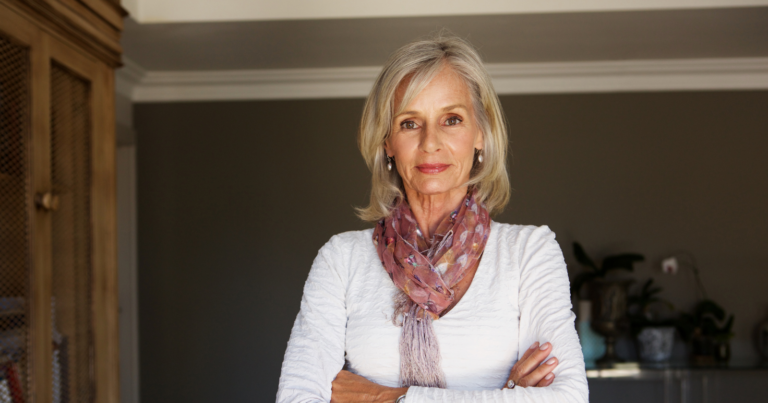
A few months after I retired, I went to a dinner party. Someone I’d never met asked me the question that used to feel like the easiest in the world to answer: “so, what do you do?”
I opened my mouth — and nothing came out.
For four decades, that answer had rolled off my tongue. I was an educator. A career coach. An executive manager. A woman who led teams and ran programs and sat in rooms where things got decided. I’d said it so many times it felt like a fact about the world, as obvious as my name.
But standing there with a glass of wine in my hand, I suddenly didn’t know what to say. “I’m retired” felt like a non-answer. “I used to be…” felt like a eulogy. And anything else felt like making things up.
If you’ve ever had a moment like that — small, awkward, and strangely disorienting — you are not alone. It’s because you’ve bumped into one of the most important questions of this whole stage of life. Who are you, when you’re not your job title anymore?
The role identity trap
Here’s something that took me years to understand: for most of our adult lives, the question “what do you do?” isn’t really a question about your work. It’s a question about who you are. And we’ve all been trained to answer it with a role.
I’m a teacher. I’m a nurse. I’m in management. I run a business. Over time, those answers stop being descriptions of what fills our days. They become the scaffolding of our identity. They tell us where we belong, who to spend time with, what we’re supposed to care about, how to measure whether today was a good day.
And then retirement arrives, and that scaffolding comes down in a matter of weeks. Sometimes in a single afternoon. You hand back the security pass, pack up the desk, and walk out into a life where no one is waiting for you to be the person you’ve been for forty years.
The freedom is real. So is the disorientation. And anyone who tells you to just “relax and enjoy it” has probably never actually been through it.
The difference between who you played and who you are
The shift that changed everything for me was learning to tell the difference between two kinds of identity — and understanding that only one of them retired.
Your role identity is the title. The position. The function you served. “Executive manager.” “Head nurse.” “Owner of the shop.” “Secondary school principal.” These are real and they matter. They shape decades of your life. And when they end, it’s legitimate to grieve them.
But your core identity is different. It’s the person underneath the role. It’s made up of your values, your natural strengths, the things that light you up whether or not anyone is paying you to do them. It’s the qualities people have always noticed about you — the steadiness, the curiosity, the warmth, the way you can walk into a tense room and make it easier to breathe.
Your role identity retired. Your core identity didn’t. It can’t. It’s not something you do — it’s who you are. And one of the most important tasks of this next chapter is learning to see it clearly, maybe for the first time.
What I discovered when the role disappeared
I’ll give you an example from my own story. When I was an executive manager, one of the things I loved most wasn’t running meetings or hitting targets. It was sitting with someone who was stuck — professionally, personally, emotionally — and helping them find a way forward. I lived for those conversations. They were the moments when my whole day felt like it had mattered.
For years, I thought that was just part of the job. Something I happened to be good at. But when I retired and those conversations stopped happening naturally, I felt the absence so keenly that I realised something important: it was never about the job. The job just gave me a reason to do what I was already wired to do.
Once I saw that, I started looking for ways to keep doing it — without needing a title to justify it. I started creating courses. None of it looked like my old career. But all of it was an expression of the same thing underneath. That’s what rebuilding identity after retirement looks like. It’s not about finding a new role to replace the old one. It’s about recognising what was always true about you, and giving it a new home.
I’ve recorded a video version of this article.

Three questions to help you see yourself clearly
Here’s a simple exercise that I now share. You can do it in about fifteen minutes with a pen and a piece of paper, or a note on your phone. It’s just three questions, but they can open up more than you’d expect.
First: what are three qualities people have always appreciated about you? Not skills — qualities. The thing your colleagues thanked you for when you left. The thing you’ve heard over and over again across decades, in different settings, from different kinds of people. That’s not a coincidence. That’s a signal.
Second: what activities make you lose track of time? Not because you’re supposed to enjoy them. Not because they’re productive. Because something in you comes alive when you’re doing them and the clock just disappears. Gardening. Reading. A long conversation with a friend. Writing. Cooking. Making something with your hands. Whatever it is, pay attention — it’s telling you something about your wiring.
Third: what would you do more of if you didn’t care what anyone thought? This is the hardest one, because most of us have spent decades filtering our answers through what other people might think. Try to answer it honestly, even if the answer seems silly or impractical. Especially then.
Don’t try to turn your answers into a plan. Just let them sit there for a day or two and see what they feel like. That’s usually enough to start loosening the grip of the old story.
What rebuilding actually looks like
Rebuilding your identity after retirement isn’t a project you finish. It’s a slower, quieter kind of work — closer to remembering than constructing. The person you’re looking for isn’t someone new you need to become. She’s the person who was there underneath the role all along, waiting for you to give her a little room to breathe.
That dinner party where I couldn’t answer the question? I went home and felt embarrassed for about an hour, and then something softened. I realised the silence was actually honest. I didn’t know how to answer yet. And that was okay. I was between stories.
These days, when someone asks me what I do, I say something like: “I guide people through the transition into retirement through my courses, and I write about what I’ve learned along the way.” But underneath that, the real answer is simpler. I’m still the same woman who loves helping people see what’s possible for them. The role changed. I didn’t.
Yours hasn’t either.
One of the first exercises in my course Your Retirement, Your Way helps you separate who you were professionally from who you’re becoming. It’s the starting point for everything else — and if this article has stirred something in you, the course gives you a guided, structured way to take it further. Take a look here.