We’ve been measuring loneliness wrong. We count close friends, tally family visits, track how often we attend gatherings — and when those numbers look reasonable, we assume we’re fine. Meanwhile, the interaction that actually anchors someone’s week might be a two-minute exchange with a pharmacist who asks how the knee is healing, or a grocery clerk who says “haven’t seen you in a while” with genuine curiosity. We’ve built our entire understanding of social connection around depth, and we’ve almost completely overlooked frequency of recognition.
Conventional wisdom tells us that what matters is deep, intimate relationships — the inner circle, the ride-or-die friends, the partner who truly knows you. And yes, those bonds are irreplaceable. But that framing has created a blind spot so large that millions of people who technically “have people” still feel invisible most days. Research suggests that for many people, especially those navigating retirement or living alone, belonging doesn’t require emotional intimacy. It requires being recognized.
That distinction changes everything.
The person behind the counter who knows your order
Sociologists have a term for the people we interact with regularly but don’t know well: weak ties. Your mail carrier. The woman at the dry cleaner. The guy who works the morning shift at the coffee shop where you’ve gone every Thursday for three years. These relationships feel so minor that most people wouldn’t even call them relationships.
And yet weak ties perform a function that close relationships sometimes can’t. They tell your brain: you exist in this place, among these people, and they notice you. That signal — subtle, easy to dismiss — activates something fundamental. When someone remembers your name or your usual order, your nervous system registers safety and social placement. You belong here. You’re a regular. You’re known.
For someone who left a career six months ago and suddenly has no office, no team meetings, no daily reason to be anywhere specific, that signal can become a lifeline. I’ve written before about how the community you thought you belonged to was actually your workplace, and the aftermath of that realization hits harder than most people expect.
What fills the gap? Often, it starts with something astonishingly small.
Why recognition hits differently than conversation
There’s a meaningful difference between someone engaging you in conversation and someone simply acknowledging that you’re here again. Conversation requires energy, mutual interest, social skill. Recognition requires only continuity. And continuity is something almost anyone can build.
Walk into the same bakery every Saturday morning. Sit in the same seat at the library. Bring your dog to the same park at the same time. Within weeks, faces become familiar. Within a month or two, nods become greetings. The woman on the bench starts asking about the dog’s name. The barista starts making your flat white before you order it.
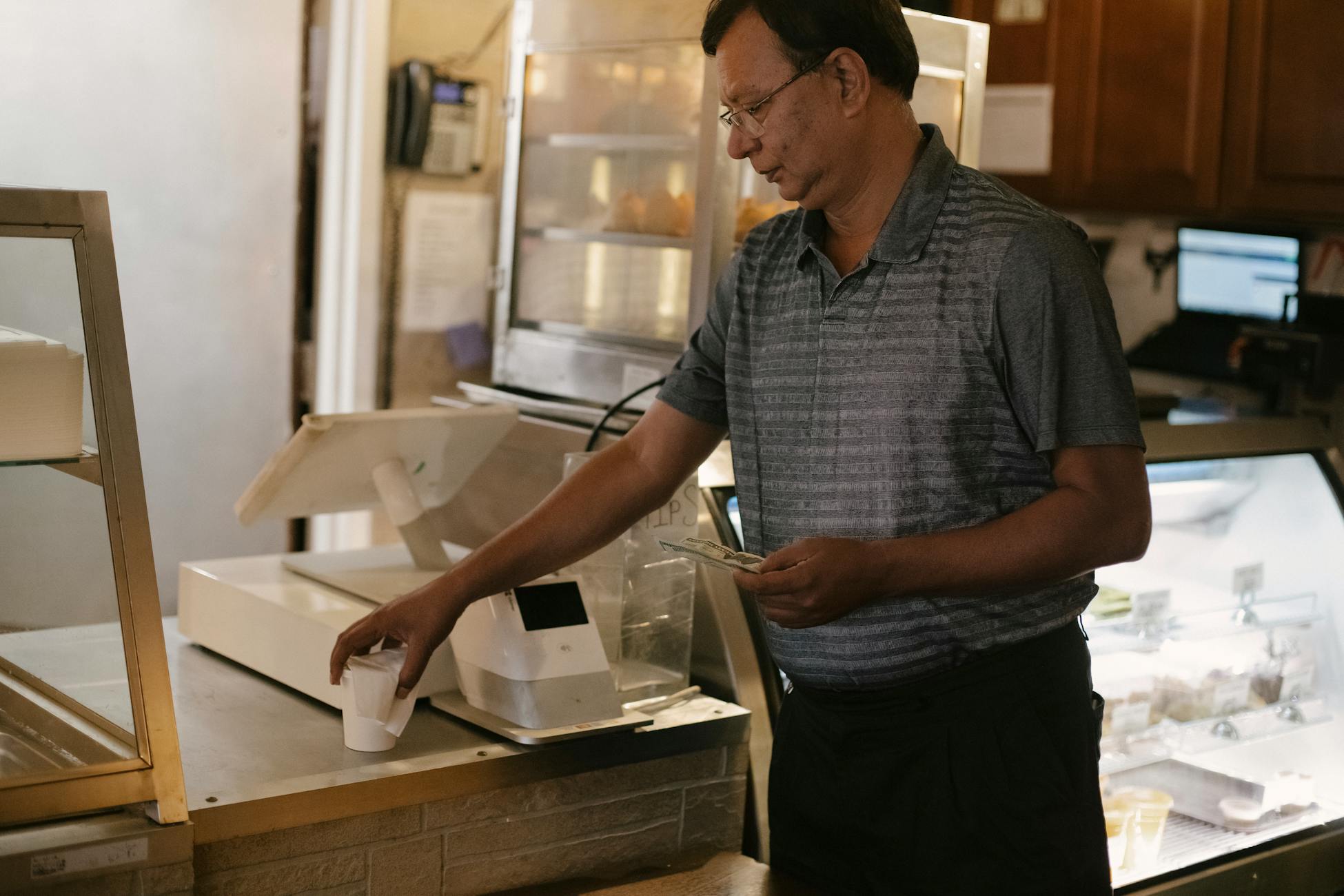
None of this registers as “social connection” on any survey. No one would list the barista as a source of support. But the cumulative effect of being recognized — repeatedly, predictably, without effort — does something powerful to the brain’s threat assessment. Social isolation can have significant effects on mental and physical health, and familiar faces in familiar places may help buffer against these effects.
The effect is quiet. You don’t walk out of a café thinking “my cortisol just dropped.” You walk out thinking the morning felt okay. That’s enough.
The retirement problem no one talks about at the planning seminar
Financial planners ask how much you’ll need per month. They don’t ask how many people will recognize your face on a given Tuesday. And yet the second question may be just as important for well-being as the first for many retirees.
I’ve watched it happen over and over in my coaching work. Someone retires with plenty saved, a comfortable home, a spouse, maybe adult children nearby. On paper, they’re set. Six months in, something feels wrong and they can’t name it. They’re not lonely in the dramatic, cinematic sense. They still see people. But the daily texture of being part of something — the hallway greetings, the shared coffee run, the security guard who always had a joke — vanished overnight.
The hardest part of retirement rarely involves money. It involves the evaporation of micro-belonging — those dozens of tiny recognition moments that employment provided without anyone noticing.
Building a web of familiar faces on purpose
Here’s what I find most people resist: you can construct this deliberately. It feels like it should be organic, like belonging ought to find you. But belonging finds people who put themselves in the path of repetition.
The mechanics are straightforward. Choose three to five places you’ll visit on a regular schedule. A café, a bookshop, a gym, a farmer’s market, a community garden. Go at the same time, on the same days. Be friendly enough to be remembered but don’t force connection. Just show up. Over and over.
What happens next is almost inevitable. Humans are pattern-recognition machines. The staff will start to know you. Other regulars will notice you. You’ll develop the kind of nodding-acquaintance relationships that feel minor but function as anchors.
A woman I worked with several years ago described her post-retirement strategy as “building a neighborhood inside a city.” She didn’t try to make best friends. She cultivated familiarity across seven or eight regular stops in her week. The result was that she could walk through most days encountering someone who knew her face. That was enough to keep her feeling embedded in the world.

Community engagement research suggests that repeated, low-stakes social presence may serve as an important buffer against the health consequences of isolation. Deep friendships matter enormously. But for day-to-day psychological stability, breadth of recognition may matter just as much.
What the face behind the counter actually provides
Let me be specific about the mechanism. When someone behind a counter greets you by name — or even just with “the usual?” — several things happen simultaneously.
First, you receive evidence that your routine has been observed. Someone noticed your pattern. Your existence left a trace in another person’s awareness. That sounds trivially obvious, but for someone who spends most of their hours alone, it can be the only external confirmation all week that they’re visible.
Second, the exchange has a script. You know how it goes. There’s comfort in predictability, and the prefrontal cortex conserves energy when interactions follow expected patterns. Low-effort social exchanges reduce the cognitive load that makes many isolated people avoid going out at all.
Third — and this is the one that matters most — the interaction is mutual. That barista or pharmacist isn’t performing charity. They genuinely recognize you, and your presence is part of their daily landscape too. The reciprocity makes it real. You’re not a patient or a case number. You’re a regular.
I’ve seen this dynamic sustain people through extraordinarily difficult stretches. Research on meaning and psychological well-being suggests these connections can be significant, and meaning doesn’t always arrive through grand purpose. Sometimes it arrives through a Wednesday morning at the hardware store where the guy behind the counter says, “Back for more sandpaper? Must be a big project.”
That sentence contains a world of implied belonging. He remembers what you bought last time. He’s curious. He assumes you’ll be back. You’re a person with a project, a routine, a life that intersects with his.
The danger of waiting for connection to feel significant
One of the patterns I notice in people who struggle with isolation after sixty is a tendency to dismiss small interactions as meaningless. They’re waiting for something that counts — a dinner party, a deep conversation, a new close friendship. And while they wait, they skip the café, cancel the gym, let the library card lapse.
This is a mistake rooted in a particular cultural story about what connection is supposed to look like. We’ve been told that real connection requires vulnerability, shared history, emotional risk. Social media amplifies this by showing us curated images of tight-knit friend groups and multi-generational family dinners. Anything less feels like failure.
The truth is more practical and less photogenic. People who thrive after sixty tend to maintain a wide net of low-intensity social touchpoints. They don’t put all their belonging eggs in the basket of intimate friendship. They spread recognition across their week so that almost every day includes a moment of being seen.
I explore this dynamic further in a video I made about the retirement fear no one talks about—how we often underestimate the loss of these daily interactions until they’re suddenly gone. It’s not just about missing work itself, but losing that entire layer of familiar faces who anchor us in the world.

That’s a strategy, not a consolation prize.
Small rituals, accumulated
I keep a practice I’ve maintained for decades: remembering details. Birthdays, follow-up questions, the name of someone’s grandchild. It takes almost no effort to ask “how did the recital go?” — but the effect on the other person’s face is always disproportionate to the cost. They light up. Someone remembered.
This works in reverse, too. When I walk into my regular haunts and someone remembers my details, I feel something shift in my chest. A small settling. A sense that the world has a place for me in it today.
If you’re reading this and recognizing a gap in your own week — days that pass without anyone acknowledging your presence — I’d gently suggest starting with one place. Pick somewhere you already go. Go more consistently. Learn a first name. Offer yours.
You don’t need to explain what you’re doing or why. You’re just becoming a regular somewhere. And that act of repetition will begin to generate exactly the kind of recognition that keeps the human nervous system from drifting into alarm mode.
A culture of well-being and belonging isn’t built through grand gestures or institutional programs alone. It’s built through the accumulated weight of showing up, being noticed, and noticing in return.
A familiar face behind a counter will never replace a close friend. It doesn’t need to. What it provides is something more immediate and, in some weeks, more necessary: proof that your daily life has witnesses. That someone would notice if you stopped coming in.
For a lot of people, especially those navigating the unmarked terrain of retirement, that proof is the difference between a week that feels survivable and one that feels like disappearing.
If this resonates and you’re in the process of rethinking what your post-career life actually needs to contain, my free guide “Thrive In Your Retirement” walks through some of the less obvious building blocks — including the social architecture that no financial planner will mention.
I built Your Retirement Your Way because I kept seeing people step into retirement without realizing how profoundly their sense of connection and purpose would shift—sometimes those small, everyday interactions we take for granted become lifelines we didn’t know we’d need.
Start with one counter. One face. One name. See what a few weeks of showing up does to the texture of your days.