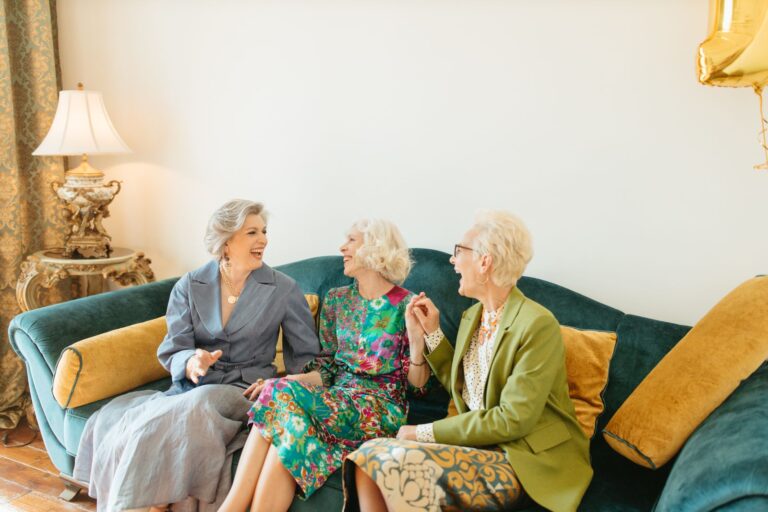
Most people can think of someone whose arrival seems to change the feel of a room. Conversation picks up, people relax, and others leave a little brighter than they arrived. It is tempting to think of this as a rare gift, a kind of natural charisma that some people simply have. Research on how moods spread and how people form impressions suggests something more ordinary and more encouraging: much of what makes someone uplifting to be around comes down to warmth, genuine attention and a good mood that others pick up on.
That is good news, because unlike charisma, those things are within most people’s reach at any age.
Moods are catching
One of the clearest demonstrations of how one person’s mood affects a group comes from an experiment by Sigal Barsade, then at Yale University, published in 2002 in the journal Administrative Science Quarterly.
Barsade placed 94 university students into small groups to complete a task together. Each group included a trained actor, a drama student posing as another participant, who had been coached to display one of four moods: cheerful enthusiasm, calm warmth, hostile irritability or low, sluggish gloom.
According to the published study, the actor’s mood spread to the rest of the group, both in how members said they felt and in how observers rated their behaviour. When the mood was positive, groups cooperated more, had less conflict and believed they had performed better.
One detail is especially interesting. The study did not find that high-energy moods spread more than calmer ones. A quietly warm person, in other words, may lift a group just as much as an exuberant one. Lighting up a room does not seem to require being the loudest person in it.
The contagion also worked in the other direction. Irritable and gloomy moods spread through the groups too, which is a useful reminder that the effect a person has on others is not always a positive one. Someone who arrives tense or short-tempered can shift a room just as surely as someone who arrives in good spirits.
Happiness tends to cluster among friends
In a 2008 study published in the BMJ, James Fowler and Nicholas Christakis followed 4,739 participants in the Framingham Heart Study over about 20 years. People with happy friends living nearby were more likely to report being happy themselves. The researchers also found an association among next-door neighbours.
Friends and neighbours can share circumstances that shape how they feel. The study shows that happiness clustered among people who were connected, while Barsade’s experiment tested how a person’s mood could affect a group in a controlled setting.
People who leave others energised
Researchers studying workplaces have looked at a similar quality from another angle. In a 2003 article in the MIT Sloan Management Review, Rob Cross and his colleagues Baker and Parker reported on their study of energy in the working relationships of three organisations: a consulting firm, a group of statisticians and a group of engineers. They described energy as a kind of positive emotional arousal that people experience in their interactions with one another.
Related Stories from Jeanette Brown
- What I’ve learnt since becomimg an empty nester
- Teenage grandchildren may want more time with friends, but research suggests the bond can stay strong, and that the quality of the relationship matters more than how often you see them
- Saying ‘sorry to bother you’ or ‘whatever you want is fine’ can seem kind, but research suggests that always putting others first can quietly wear away our sense of self
Cross has since spent years studying these “energisers.” In a 2021 interview with McKinsey, he described them as people who help others see realistic ways to connect their work with what they personally care about, and who spend much of their time with others exploring those people’s interests and aspirations rather than only the task at hand.
Importantly, he noted, energisers are not simply cheerleaders. “You’re just as likely to hear them disagree as agree,” he said. What sets them apart, in Cross’s account, is the attention they pay to what matters to other people, not a willingness to agree with everything.
Warmth is noticed first
Part of the reason these qualities matter so much lies in how people size each other up. Psychologists have found that impressions of others largely come down to two broad judgements: how warm a person seems, meaning whether they appear friendly and well-intentioned, and how competent they seem.
According to a summary of the research in In-Mind magazine, co-written by psychologist Susan Fiske, warmth tends to be judged first and weighs more heavily, with competence the secondary factor. One study cited in the article found that people form impressions of warmth within a fraction of a second.
That may help explain why the people who light up a room are often remembered more for how they made others feel than for how clever or accomplished they were.
What anyone can do
None of this research offers a personality test, and it would be a mistake to read it as a list of traits that some people have and others lack. What it does suggest is that the qualities involved are largely about behaviour, and behaviour can be practised.
Bringing a genuinely good mood into a room, rather than a forced one, appears to influence others. Giving people full attention and showing real interest in what matters to them is what energisers seem to do. Warmth, shown through friendliness and goodwill, shapes first impressions more than polish does. And staying in regular contact with friends and neighbours is one way to stay connected.
These may be especially worth remembering in later life, when people often have more time for friends, family and community, and when the effect of a warm presence on a grandchild, a neighbour or a new acquaintance can be considerable.
What the research cannot say
The research has limits. Barsade’s experiment involved university students working briefly in a laboratory. The Framingham analysis tracked how happiness clustered in a network but cannot prove that one person’s happiness caused another’s. The work on energisers comes largely from workplaces, and much of what has been written about it draws on interviews rather than controlled studies.
Still, the pieces fit together. Moods are contagious, warmth is noticed quickly and remembered, and people who leave others feeling energised do so mainly by paying attention to them. On this evidence, lighting up a room has less to do with being the centre of attention than with making others feel noticed, welcomed and a little happier for having been there.
Related Stories from Jeanette Brown
- What I’ve learnt since becomimg an empty nester
- Teenage grandchildren may want more time with friends, but research suggests the bond can stay strong, and that the quality of the relationship matters more than how often you see them
- Saying ‘sorry to bother you’ or ‘whatever you want is fine’ can seem kind, but research suggests that always putting others first can quietly wear away our sense of self
Feeling lost or unfulfilled?
Jeanette Brown’s “Your Life Review” video is designed to help you identify key areas in your life that need improvement.
Through a simple yet powerful exercise, you’ll assess your current satisfaction across different life domains, allowing you to pinpoint specific areas for growth.
This life review forms the foundation for creating a clear vision, setting aligned goals, and developing a personalized action plan.
Take the first step towards a more satisfying life. Start your Life Review now and gain immediate access to this transformative exercise.