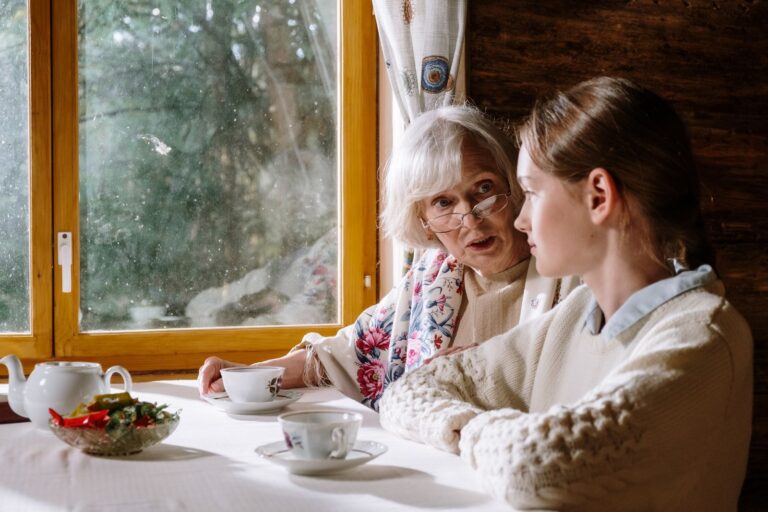
When grandchildren are small, they often race to the door when you arrive. A few years later, the same child might give you a quick hug, mumble hello and disappear back to their room or their phone. For many grandparents, the teenage years can feel like losing someone you’ve been close to since they were born.
It helps to know that this is a normal stage, not a rejection. It also helps to know that research on grandparents and older grandchildren is encouraging. The relationship can stay close through the teenage years and well beyond, and what seems to matter most is not how often you see each other, but what that time is like.
Pulling away a little is part of growing up
Teenagers are busy becoming their own people. According to the Raising Children Network, an Australian parenting website, it’s common for young people to want more independence over where they go and who they spend time with, and to want “to spend more time with friends and peers and less time with family.” Some friction with family is normal too, and the site notes that conflict tends to peak in early adolescence.
None of that means a teenager has stopped caring about their grandparents. It means the relationship needs to grow up along with them.
Quality matters more than quantity
One of the most reassuring findings comes from a 2023 study in the Journal of Family Issues. Pittman and colleagues asked 474 late adolescents to rate the quality of their relationships with each of their living grandparents, and how much contact they’d had with them in primary school. They also looked at how the young people were faring.
Those with better-quality relationships with grandparents tended to have fewer depressive symptoms, higher self-worth and more confidence in their close friendships and romantic relationships, even after the researchers accounted for how accepted they felt by their parents. The amount of contact, on its own, was not linked to those outcomes. As the authors put it, it was “grandparent relationship quality, but not grandparent contact” that mattered.
The study shows associations, not cause and effect, and more contact in childhood did strengthen some of the links. But for grandparents who live far away, or whose teenage grandchildren are simply busy, it is a hopeful message. A smaller number of good conversations may count for more than a large number of distracted ones.
The bond matters on both sides
Strong relationships with grandchildren don’t only help the young. Sara Moorman and Jeffrey Stokes of Boston College analysed a US study that followed three- and four-generation families from 1985 to 2004, including 376 grandparents and 340 adult grandchildren. In research presented at the American Sociological Association’s annual meeting in 2013, they found that emotionally close relationships went with fewer depressive symptoms in both generations.
They also found that grandparents who both gave and received practical help had the fewest depressive symptoms over time, while those who only received help had the sharpest rise. Conference papers like this one are usually not yet peer reviewed, so the findings are best read as early. But the idea that a relationship works best when it runs both ways is worth holding onto, especially with teenagers, who are starting to have things of their own to offer.
What helps keep teenage grandchildren close
Be someone they can talk to without judgement. Many teenagers have things they don’t want to discuss with their parents, and a grandparent can be a valuable safe place. The Raising Children Network describes active listening, putting aside what you’re doing and trying to understand the young person’s point of view, as “a powerful way” to strengthen relationships with teenagers. That applies to grandparents as much as parents. Lectures, comparisons with “when I was your age” and quick fixes tend to close the conversation down.
Related Stories from Jeanette Brown
- Saying ‘sorry to bother you’ or ‘whatever you want is fine’ can seem kind, but research suggests that always putting others first can quietly wear away our sense of self
- ‘What is done in the dark will come to light’ has roots in the Gospels, and research on secrets suggests it isn’t only the fear of discovery that weighs on us
- Finding a friend who really gets you can take time in later life, but research suggests where to look, and why letting people see the real you is part of how you find them
Meet them where they are. Teenagers live a lot of their lives online. In a 2024 Pew Research Center survey of 1,391 American teens aged 13 to 17, 46% said they were online “almost constantly”, and most used apps such as YouTube, TikTok, Instagram or Snapchat. Grandparents have been adapting too. An AARP survey of 2,654 American grandparents found that the share who contacted grandchildren by phone fell from 70% in 2011 to 46% in 2018, as more turned to group texting and video chat. A short, funny text or a photo of the dog may be answered far more quickly than a phone call.
Take an interest in their world. Ask about the music they’re into, the game they play, the subject they love or hate at school, and the friends they keep mentioning. You don’t have to like it all. Genuine curiosity tells a teenager that you’re interested in who they are now, not just who they were at six.
Offer, don’t insist. Teenagers value having a say. An invitation to a one-on-one outing, such as a movie, a fishing trip, driving practice or lunch somewhere of their choosing, tends to land better than an expectation that they’ll be at every family gathering. Time alone with a grandparent, away from siblings and parents, can make it easier for a teenager to open up.
Let them help you. The Boston College research suggests relationships work best when support flows both ways. Ask a teenage grandchild to show you how to set up a group chat, edit a photo or choose a podcast. It gives them a chance to be the expert, and it’s often the start of a good conversation.
Notice what’s going well. The Raising Children Network suggests focusing on the positive with teenagers, especially when things are tense: praising strengths such as being a good friend or trying hard at school. Teenagers often hear plenty about what they’re doing wrong. A grandparent who notices what they’re doing right, and says so, can become someone they want to be around.
Be careful online. Being connected on social media can be a lovely way to keep up with a teenager’s life, but some young people are sensitive about how they appear to their friends. A private message is usually safer than a public comment on their posts, and asking before sharing photos of them is a simple courtesy that shows respect for their growing independence.
Stay on good terms with their parents. Parents still shape how much time teenagers spend with grandparents. In a survey of 1,478 young people aged 11 to 16 in England and Wales, Shalhevet Attar-Schwartz, Jo-Pei Tan and Ann Buchanan found that teenagers felt closer to their closest grandparent, and gave more weight to that grandparent’s views, when they saw them more often and when the parents got on well with the grandparent. The authors described parents as gatekeepers. Supporting the parents’ rules, rather than quietly undermining them, protects your place in your grandchildren’s lives.
A relationship that grows up with them
The teenage years can feel like a quieter chapter between grandparents and grandchildren. The hugs may be briefer and the visits less frequent. But the research suggests that the quality of the relationship, the sense that a grandparent really knows and accepts them, is what teenagers carry with them.
The grandchild who seems distant at 15 may well be the adult who rings for advice at 25, or brings their own children to visit at 35. The groundwork for that is laid now, one conversation at a time.
Related Stories from Jeanette Brown
- Saying ‘sorry to bother you’ or ‘whatever you want is fine’ can seem kind, but research suggests that always putting others first can quietly wear away our sense of self
- ‘What is done in the dark will come to light’ has roots in the Gospels, and research on secrets suggests it isn’t only the fear of discovery that weighs on us
- Finding a friend who really gets you can take time in later life, but research suggests where to look, and why letting people see the real you is part of how you find them
Feeling lost or unfulfilled?
Jeanette Brown’s “Your Life Review” video is designed to help you identify key areas in your life that need improvement.
Through a simple yet powerful exercise, you’ll assess your current satisfaction across different life domains, allowing you to pinpoint specific areas for growth.
This life review forms the foundation for creating a clear vision, setting aligned goals, and developing a personalized action plan.
Take the first step towards a more satisfying life. Start your Life Review now and gain immediate access to this transformative exercise.