Ask adults what a grandparent used to say to them and some can answer straight away. A saying at the front door, a nickname, a line repeated every time a biscuit tin was opened. Words like these can stay with a person for decades.
No study has tracked which particular phrases grandchildren carry into adulthood, and anyone who claims to know the definitive list is guessing. What research does offer is something more useful: careful work on how the way adults talk with young children shapes what those children remember, how they see themselves and how they cope later on. Most of it was done with parents, not grandparents. But the same kinds of conversations happen at a grandparent’s kitchen table, and the findings translate naturally.
One honest caveat first. Very little said to a baby or young toddler will be remembered as words. In a 2018 study in Psychological Science, Shazia Akhtar, Martin Conway and colleagues asked 6,641 people for their earliest memory. The average age of that memory was 3.2 years. Nearly 40 percent of people placed their earliest memory at age 2 or younger, and the researchers considered those memories unlikely to be genuine. What lasts from the early years is less the sentence than the pattern of talk, and the relationship it builds.
“Do you remember when…?”
Few phrases have better research behind them. At the University of Otago in Dunedin, psychologists Elaine Reese and Rhiannon Newcombe trained half of a group of 115 mothers to talk with their toddlers about shared past events in a particular way: asking open questions, adding new details, confirming what the child said and following whatever part of the memory the child found most interesting. After a year, the children of trained mothers remembered more details and told more complex stories about the past. Because half the mothers received the training and half did not, the study, published in Child Development in 2007, was an experiment rather than an observation.
A later Otago study involving Reese followed a much smaller group of 17 children. Those whose mothers had talked about the past in this rich, elaborative way between ages 2 and 4 reported earlier first memories when they were interviewed at 12 and 13.
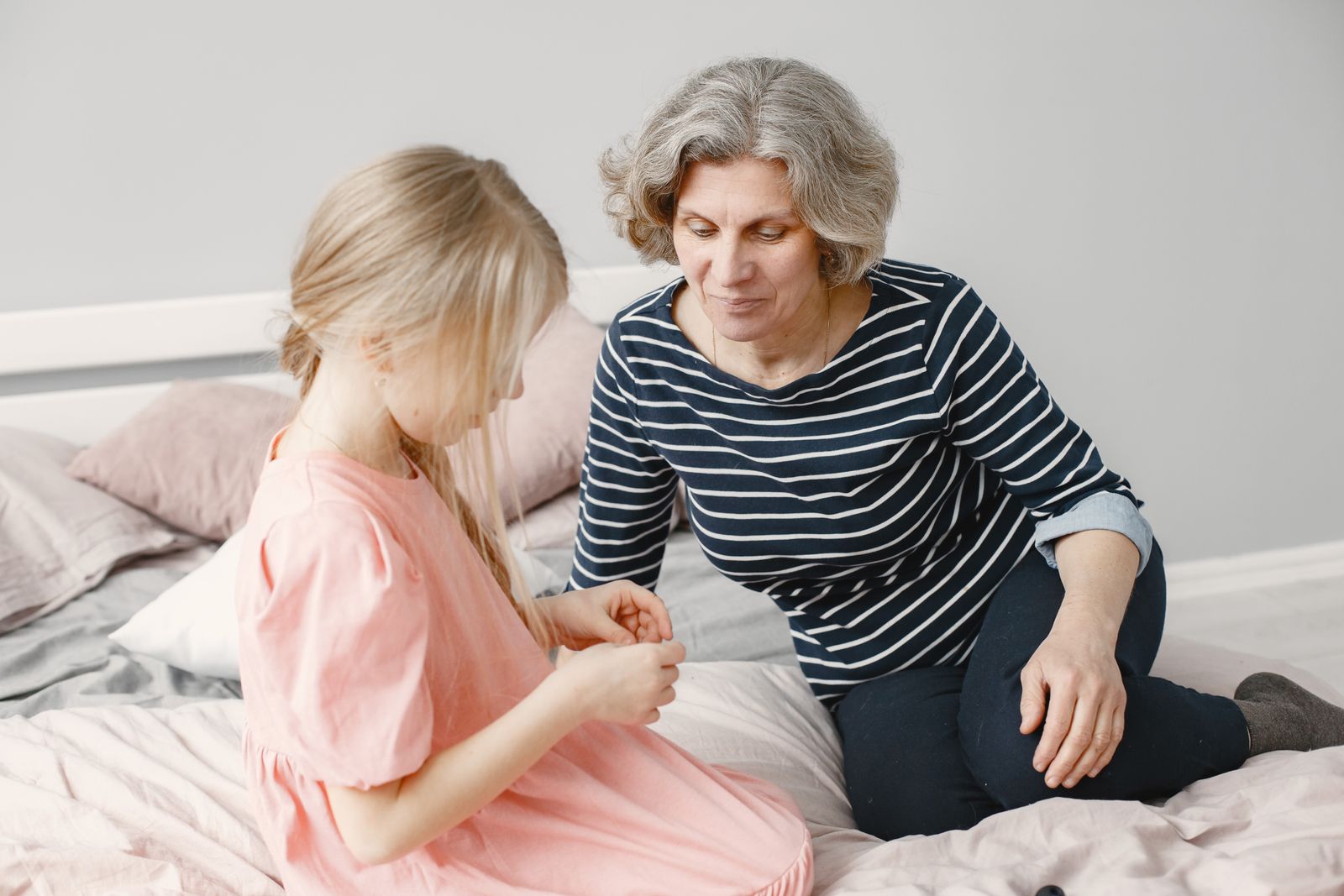
For a grandparent, the practice is simple. “Do you remember when we went to the beach and the seagull took your sandwich? What happened next?” Then listen, add a detail or two, and let the child lead.
“You worked hard on that”
How children are praised appears to matter more than how often. In a study published in Child Development in 2013, Elizabeth Gunderson, Carol Dweck and colleagues filmed 53 families at home when the children were 1, 2 and 3 years old, and sorted every piece of praise into types. Praise for effort and actions, such as “you worked hard on that,” was one kind. Praise for fixed traits, such as “you’re so smart,” was another.
Five years later, at 7 and 8, the children who had heard a higher share of effort praise were more likely to prefer challenging tasks, to come up with strategies when things went wrong and to believe that intelligence can grow. The total amount of praise made no difference. The study was small and observational, so it shows a link rather than proof. Still, “you kept going even when it was tricky” costs nothing to say.
“When I was your age…”
Grandparents hold a family’s history, and the stories are worth telling. Researchers at Emory University in Atlanta, Robyn Fivush and Marshall Duke, recorded dinnertime conversations in 40 families and asked children aged 9 to 12 questions such as how their parents met and where their grandparents grew up. Children who knew more of their family’s history tended to have higher self-esteem, get on better with other children and show more resilience. “There seems to be something that’s particularly important about children knowing where they came from,” Fivush said.
Related Stories from Jeanette Brown
- A smile returned can be enough: in a study on a busy university walkway, passers-by who got even brief eye contact from a stranger felt less disconnected than those who were looked straight through
- The art of grandparenting: 8 things that make grandchildren look forward to your visits
- I love my partner, but we don’t need to spend every waking hour together—something retirement took a while to teach us
The stories don’t need to be grand. The time the car broke down on the way to a wedding will do, especially if it went wrong and everyone survived.
“It’s all right to feel sad”
The same Emory project found that families who talked openly about the feelings around hard events, such as the death of a relative or a pet, had children with higher self-esteem and a stronger sense of control. Grandparents often have the time and the steadiness for these conversations, and the experience to say, truthfully, that sad things pass.
As with most of this research, the Emory findings come from a small group and show associations. Children with more secure family lives may simply have more of these conversations.
“Tell me all about it”
Children notice which adults are genuinely interested in them. In a 2019 study in JAMA Pediatrics, Christine Bethell of Johns Hopkins University and colleagues asked 6,188 adults in Wisconsin about seven positive experiences from their childhood. One was having at least two adults other than their parents who took a genuine interest in them. Others included being able to talk with family about feelings and feeling that family stood by them in hard times.
Compared with adults who recalled zero to two of these seven positive experiences, those who recalled six or seven had 72 percent lower adjusted odds of depression or poor mental health. That figure reflects the combined experiences, not the effect of one interested adult. The study relied on people’s memories of childhood and can’t show cause and effect. But a grandparent is about as natural a candidate as there is for one of those two interested adults, and “tell me all about it,” followed by real listening, is how that interest sounds.
“What do you think happens next?”
Reading together is one of the most familiar things grandparents do, and the questions asked along the way may matter as much as the story. A technique called dialogic reading turns the child into the storyteller. Instead of reading straight through, the adult pauses to ask open questions, such as “What’s happening here?” or “What do you think happens next?”, and builds on whatever the child says.
In a randomised trial published in Early Childhood Research Quarterly in 1998, Christopher Lonigan and Grover Whitehurst trained parents and child care teachers to read this way with 3- and 4-year-olds from mostly low-income families. After six weeks of 10-minute daily sessions, children in the shared-reading groups showed gains in parts of their expressive language, the words and descriptions they could produce themselves, compared with a control group. The effects varied between child care centres and depended on how consistently the reading was done.
The study involved parents and teachers rather than grandparents, and it measured language, not memories. But the habit translates easily to a grandparent’s lap. A favourite book read the same way visit after visit, with the same questions and the same jokes, is an easy ritual to build into the time you spend together.
The words and the person
None of these phrases is magic, and a child is unlikely to remember a sentence that was said once. What the research keeps returning to is the habit behind the words: asking about the past, noticing effort, sharing where the family came from, making room for feelings and listening properly. Repeated over years of visits, those habits seem a far likelier source of the sayings grown-up grandchildren find themselves quoting than any single clever line.
Related Stories from Jeanette Brown
- A smile returned can be enough: in a study on a busy university walkway, passers-by who got even brief eye contact from a stranger felt less disconnected than those who were looked straight through
- The art of grandparenting: 8 things that make grandchildren look forward to your visits
- I love my partner, but we don’t need to spend every waking hour together—something retirement took a while to teach us
Navigating Life’s Transitions with Jeanette Brown
Jeanette Brown is here to guide you through life’s transitions.
On her YouTube channel, she offers practical advice and supportive strategies to help you manage personal and career changes effectively.
Her videos focus on fostering resilience and equipping you with the skills needed for self-coaching.
Subscribe here to start mastering your life transitions today.
Related Stories from Jeanette Brown
- A smile returned can be enough: in a study on a busy university walkway, passers-by who got even brief eye contact from a stranger felt less disconnected than those who were looked straight through
- The art of grandparenting: 8 things that make grandchildren look forward to your visits
- I love my partner, but we don’t need to spend every waking hour together—something retirement took a while to teach us
Feeling lost or unfulfilled?
Jeanette Brown’s “Your Life Review” video is designed to help you identify key areas in your life that need improvement.
Through a simple yet powerful exercise, you’ll assess your current satisfaction across different life domains, allowing you to pinpoint specific areas for growth.
This life review forms the foundation for creating a clear vision, setting aligned goals, and developing a personalized action plan.
Take the first step towards a more satisfying life. Start your Life Review now and gain immediate access to this transformative exercise.